
AI / WORKING NOTE
Jevons’ Paradox, AI, and Knowing When to Stop
More prompts. More tokens. Tiny improvements. When creating becomes easier, knowing when to stop becomes its own skill.
Read about Jevons’ Paradox today, and it immediately made me think about AI.
As a business analyst, I’ve always felt that my first draft of a requirement document is usually the strongest. 😊 It captures the real problem before overthinking kicks in.
Surprisingly, I’m finding something similar with AI. The first prompt often gives me exactly what I need.
Then comes the endless tweaking.
More prompts. More tokens.
Tiny improvements.
The final, final version.
When easier turns into more
Maybe that’s my everyday AI analogy for Jevons’ Paradox: the easier AI makes creating, the more I find myself optimizing—even when the first draft was already good enough.
This is a personal reflection, not a claim that every extra prompt demonstrates the economic paradox. But it’s a useful question to ask myself: am I improving the outcome, or just producing another version?
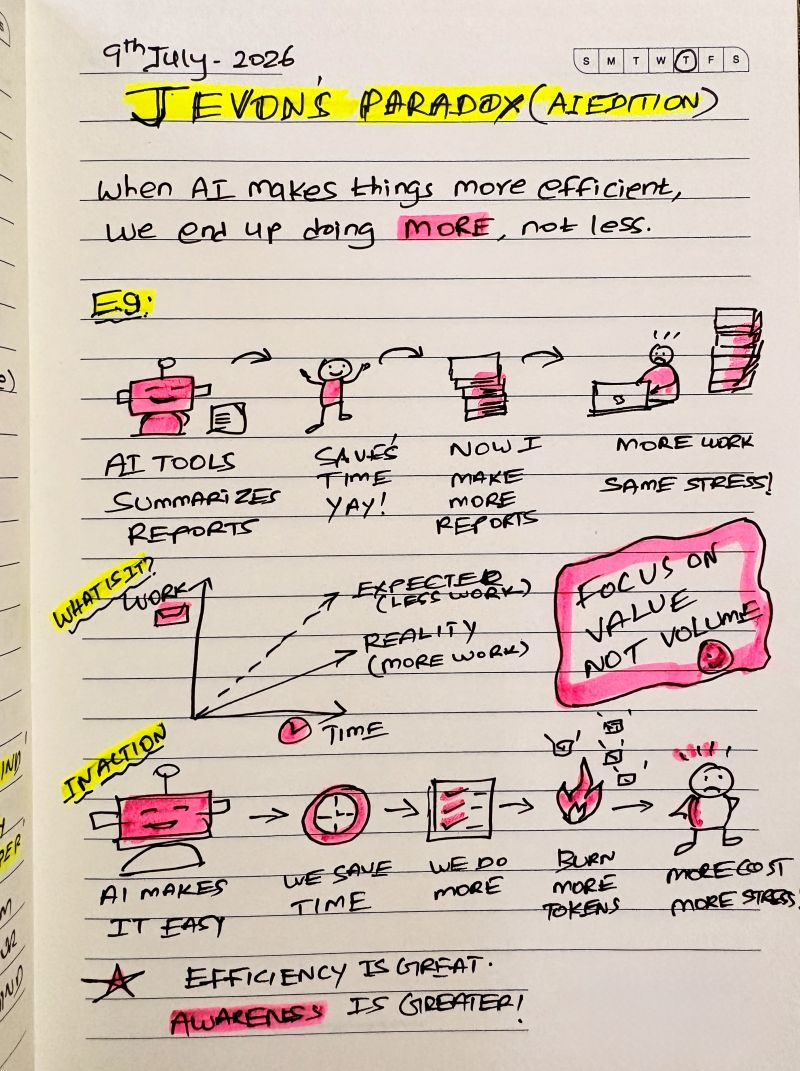
Value, not volume
Some revisions matter: fixing an error, clarifying a requirement, or checking an assumption. Others just keep the loop going.
For me, the distinction is whether the next iteration adds something useful—not simply whether another iteration is possible.
Sometimes the best optimization is simply knowing when to stop.
Efficiency is great. Awareness is greater.
Adapted from my LinkedIn post.